
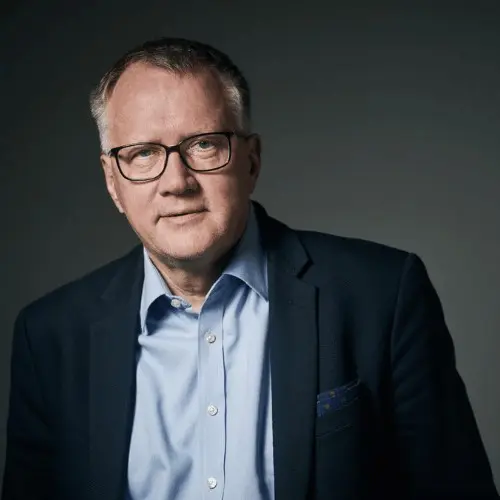
Arvils Ašeradens
Minister at Ministry of Finance
Type: Panelist
Arvils Ašeradens has served as Latvia’s Minister of Finance since December 2022. As Minister of Finance, he has prioritised strengthening Latvia’s financial sector resilience, capital market development, digital finance and innovation, as well as ensuring sustainable public finances amid changing geopolitical and economic conditions.
A long-standing member of the Latvian Parliament (Saeima). Over the course of his parliamentary career, he has worked extensively on economic, financial and structural reform issues at both national and European levels. From 2016 to 2019, he served as Minister of Economics. He has also previously served as Parliamentary Secretary at both the Ministry of Finance and the Ministry of Welfare.
Before entering politics, Ašeradens built his career in the private sector as an entrepreneur and business executive, providing him with first-hand insight into the investment climate, capital development and business growth challenges.
A long-standing member of the Latvian Parliament (Saeima). Over the course of his parliamentary career, he has worked extensively on economic, financial and structural reform issues at both national and European levels. From 2016 to 2019, he served as Minister of Economics. He has also previously served as Parliamentary Secretary at both the Ministry of Finance and the Ministry of Welfare.
Before entering politics, Ašeradens built his career in the private sector as an entrepreneur and business executive, providing him with first-hand insight into the investment climate, capital development and business growth challenges.
Appears in:
Wednesday15:00 - 15:40
Whose Money, Whose Rules? Europe, the Digital Euro, and the Stablecoin QuestionTrack: Future of Payments and Financial InfrastructureAs digital money scales globally, control is increasingly contested. This session explores the ECB’s regulatory perspective, the role of the digital euro, and the rapid expansion of US-backed stablecoins. We examine how regulation, monetary sovereignty, and market adoption intersect, and what Europe can realistically influence in a world where private digital currencies already move at global speed.